
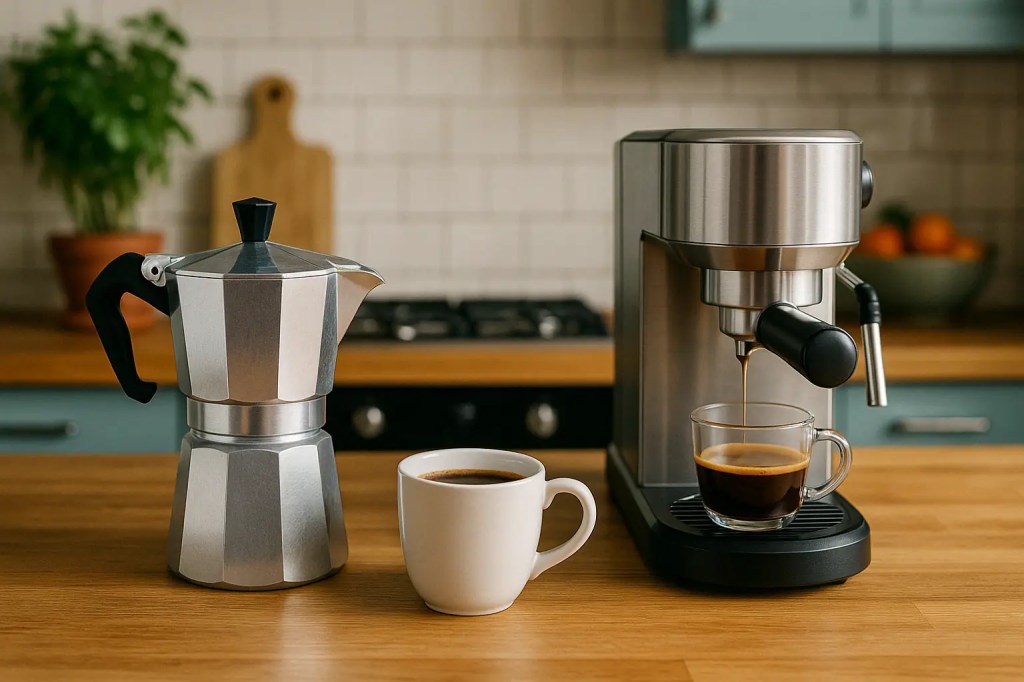
Craving that intense, concentrated coffee kick at home? You may have narrowed your options down to two popular contenders: the classic Moka Pot and the modern Espresso Machine. Both promise strong coffee, but they operate on fundamentally different principles and deliver surprisingly distinct results.
One is an affordable stovetop icon, the other a potentially pricey gateway to café-quality drinks. Which one truly fits your budget, your counter space, and your definition of a perfect strong brew?
This comparison dives deep into the Moka Pot vs. Espresso Machine debate. We’ll explore pressure, taste, cost, ease of use, and more, helping you decide which method will best satisfy your craving for intense coffee flavor.
What is a Moka Pot? The Stovetop Concentrator
Instantly recognizable, the Moka Pot (often Bialetti brand) is a fixture in many kitchens worldwide, especially in Italy. Typically made of aluminum or stainless steel, it works on your stovetop.
It has three chambers: a bottom for water, a middle funnel for coffee grounds, and a top chamber where the final brew collects. As the water heats, steam pressure (around 1-2 bars) pushes hot water up through the coffee grounds and into the top chamber.
The result is a strong, concentrated coffee, often called “stovetop espresso.” However, it’s crucial to understand this is not true espresso due to the much lower pressure involved.
You can also check our previous post, dedicated to explaining everything about the Moka Pot.
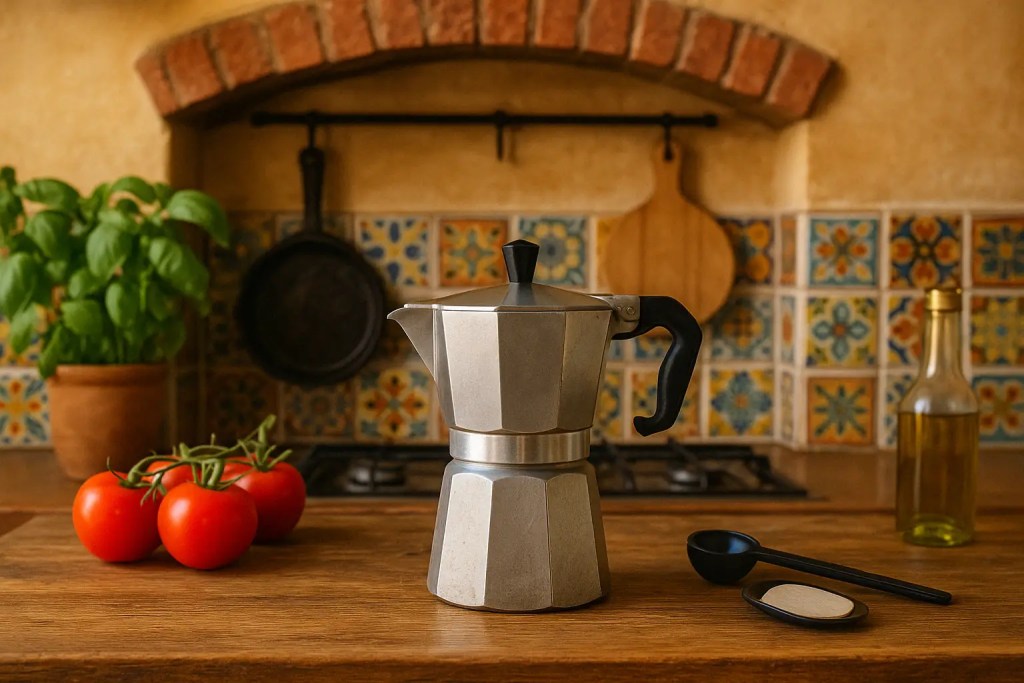
Moka Pot: the iconic Italian stove-top brewer that promises rich, strong, espresso-like coffee right in your kitchen
What is an Espresso Machine? The High-Pressure Expert
An Espresso Machine is specifically designed to create true espresso. Its defining feature is a pump (usually electric, sometimes manual via a lever) that forces hot water through a tightly packed puck of finely ground coffee at high pressure – typically 9 bars or even more.
This high pressure is key. It extracts oils and solids differently than lower-pressure methods, creating that characteristic thick, syrupy shot topped with a rich layer of reddish-brown foam called cream.
Espresso machines range from complex manual levers to user-friendly super-automatics, but the core principle of high-pressure extraction remains the same. They are the foundation for café favorites like lattes, cappuccinos, and macchiatos.

Espresso is the foundation of many well-known favorites; such as latte, cappuccino, flat white, caffe americano
Moka Pot vs. Espresso Machine: The Core Differences
Let’s compare them side-by-side:
Pressure & The Cream Question
This is the most critical difference. The Moka Pot’s ~1-2 bars of steam pressure creates concentrated coffee. The Espresso Machine’s 9+ bars of pump-driven pressure creates true espresso.
Why does this matter? That high pressure emulsifies the coffee oils and traps microbubbles of CO2, forming the signature cream on espresso. Cream significantly impacts the texture, aroma, and visual appeal. Moka pot coffee does not have true crema (any foam is thin and dissipates quickly).
Taste & Texture Profile
The pressure difference directly impacts flavor. Moka Pot coffee is strong, intense, bold, and can have a heavier, somewhat syrupy body. It can sometimes lean towards bitterness if not brewed carefully.
True Espresso offers more complexity and nuance. Depending on the beans and technique, it can be bright, acidic, sweet, or deeply chocolaty. It has a distinct viscous texture and the cream adds another layer to the mouthfeel. While intense, well-pulled espresso is often smoother than Moka pot coffee.
Grind Size & Tamping
- Moka Pot: Uses a medium-fine grind, similar to drip coffee or slightly finer. Crucially, you do not tamp the grounds; just level them off in the funnel. Tamping can create too much pressure for the system.
- Espresso Machine: Requires a very fine, consistent grind. Precise tamping (applying firm, even pressure) is essential to create resistance for the high-pressure water, ensuring proper extraction.
Cost & Investment
- Moka Pot: Extremely affordable. You can get a quality Moka Pot for $20 – $50.
- Espresso Machine: A significant investment. Entry-level electric machines start around $150-$300, capable mid-range machines often cost $500-$1000+, and high-end or super-automatic machines can run into thousands. Don’t forget the need for a capable grinder, adding to the cost.
Skill & Consistency
- Moka Pot: Relatively simple to use, but requires technique to avoid scorching or bitterness (e.g., managing heat, knowing when to stop). Consistency can vary.
- Espresso Machine: Has a steeper learning curve, especially for semi-automatic machines where you control grind, dose, tamp, and shot timing. Achieving consistent, café-quality shots takes practice. Super-automatics are easier but offer less control and cost more.
Convenience & Speed
- Moka Pot: Fairly quick once the water heats up on the stove – typically 5-10 minutes total. No electricity needed (unless using an induction stovetop adapter).
- Espresso Machine: Brew time itself is fast (25-30 seconds for a shot), but machines require warm-up time (5-30 minutes depending on the model). Needs electricity and counter space.
Maintenance
- Moka Pot: Simple cleaning. Just rinse the parts after each use (avoiding harsh soaps on aluminum) and occasionally check/replace the rubber gasket.
- Espresso Machine: More involved. Requires regular cleaning (portafilter, shower screen), periodic backflushing (for many machines), and descaling to remove mineral buildup.

Moka Pot: Pros & Cons
- Pros:
- Very affordable initial cost.
- Durable and long-lasting (especially stainless steel).
- Simple mechanism and easy to clean.
- Produces strong, concentrated coffee.
- Doesn’t require electricity or counter space (uses stovetop).
- Iconic design.
- Cons:
- Does not produce true espresso or crema.
- Flavor can be less nuanced, potentially more bitter.
- Requires careful heat management for best results.
- Needs a stovetop heat source.
Espresso Machine: Pros & Cons
- Pros:
- Produces true espresso with rich crema.
- Allows for complex and nuanced flavor profiles.
- The only way to make base for authentic lattes, cappuccinos, etc.
- Offers potential for deep hobbyist engagement.
- Cons:
- Significantly more expensive (machine + grinder).
- Steeper learning curve for consistent results (non-super-autos).
- Requires regular, more involved maintenance.
- Needs electricity and dedicated counter space.
- Can be noisy (pump and grinder).
Who Should Choose the Moka Pot?
The Moka Pot is likely your best bet if:
- You’re on a tight budget.
- You want strong, bold coffee but aren’t chasing authentic espresso/cream.
- You appreciate simplicity and durability.
- You lack counter space or prefer a stovetop method.
- You enjoy a classic, straightforward brewing ritual.
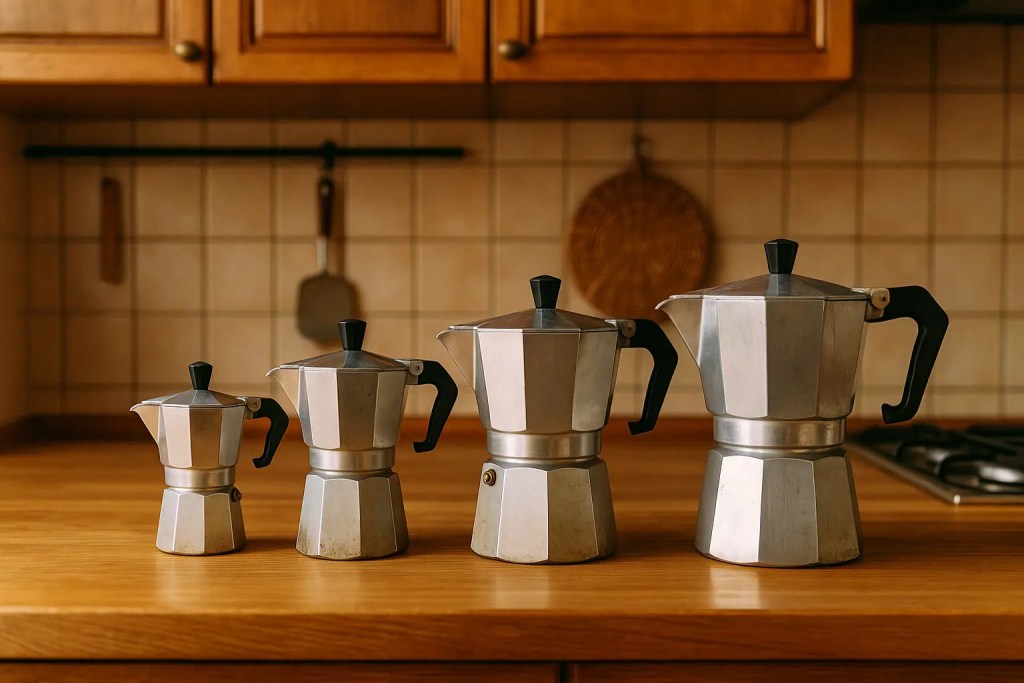
Different sizes are easily available, depending on the needs
Who Should Choose an Espresso Machine?
An Espresso Machine is the right investment if:
- You crave authentic espresso with crema.
- You want to make café-style milk drinks (lattes, cappuccinos).
- You’re willing to invest significant money in equipment (machine + grinder).
- You enjoy learning a new skill and refining your technique (or opt for a super-automatic for convenience).
- You have the counter space and budget for it.
Final Verdict: It’s About Your Coffee Goal
The Moka Pot and Espresso Machine both make strong coffee, but they aren’t interchangeable. The fundamental difference lies in pressure, which dictates everything from the presence of crema to the nuances of taste and texture.
The Moka Pot offers bold, concentrated coffee simply and affordably. The Espresso Machine offers true espresso complexity and milk drink potential, but demands a higher investment in cost and learning. Choose the one that aligns with your budget, your taste goals, and the coffee experience you truly desire.


Leave a comment