

Ordering a latte used to be simple: espresso and milk. But walk into almost any coffee shop today, and you’re presented with choices; especially when it comes to milk. While dairy milk remains the standard most of the time, oat milk has surged in popularity, becoming the popular plant-based alternative for baristas and consumers alike.
Why the buzz around oat milk? And how does it really compete against traditional dairy milk when steamed into a creamy, dreamy latte?
This showdown dives into the key differences – from steaming performance and latte art potential to taste, texture, nutrition, and more. Let’s find out which milk makes the perfect latte base for you.
The Classic Contender: Dairy Milk (Whole Milk Focus)
For decades, whole dairy milk has been the undisputed king of latte preparation, and for good reason.
- Composition Basics: Dairy milk is a natural emulsion containing milk fats, sugars (lactose), and crucially for steaming, proteins (primarily casein and whey).
- The Steaming Science: Dairy milk’s unique protein structure is key to creating microfoam. Heating unfolds these proteins, allowing them to trap air bubbles. The fat content adds richness, stability, and shine to the foam. This combination allows skilled baristas to create smooth, glossy microfoam perfect for pouring wonderful latte art. It’s predictable and consistent.
- Taste Profile: Whole milk offers a familiar, creamy, slightly sweet flavor that complements espresso beautifully without overpowering it. It adds richness and body, contributing to the comforting taste many associate with a classic latte.

Natural proteins, fats and sugars give a unique texture to coffee
The Plant-Based Champion: Oat Milk (Barista Edition)
Oat milk has risen rapidly to become the preferred dairy alternative in cafes, largely thanks to special “Barista Edition” formulations.
- Composition Basics: At its core, oat milk is made from oats and water. However, Barista Editions are specifically engineered for coffee. They typically contain added oils (like rapeseed/canola or sunflower) for richness and mouthfeel, and stabilizers or acidity regulators (like dipotassium phosphate) to prevent curdling in acidic coffee and improve steaming performance.
- The Steaming Science: These added ingredients help oat milk mimic the steaming properties of dairy milk remarkably well. The emulsified fats and stabilizers help create surprisingly stable microfoam, allowing for good latte art. While perhaps not achieving the exact same level of long-lasting gloss or elasticity as perfectly steamed dairy, it’s often considered the closest plant-based equivalent.
- Taste Profile: Oat milk has a creamy texture and a naturally subtle sweetness. Its flavor is generally considered more neutral compared to other alternatives like soy or almond, allowing the espresso’s character to come through. Some might detect a slight “oaty” background note. Crucially, it’s vegan, lactose-free, and typically nut-free.

“Oat milk has risen rapidly to become the preferred dairy alternative in cafes…”
Head-to-Head Comparison: Dairy vs. Oat Milk for Latte
Let’s put them side-by-side in the context of your latte:
Steaming & Latte Art Potential
- Dairy Milk: The benchmark. Steams predictably, creates excellent, glossy, tight microfoam ideal for detailed latte art. Very forgiving for experienced baristas.
- Oat Milk (Barista Edition): Steams exceptionally well for a plant-based milk. Creates good microfoam suitable for latte art, though it might be slightly less elastic or lose its definition faster than dairy. Considered the best plant-based option for steaming by most baristas.
- Edge: Dairy milk still holds a slight edge for peak performance and consistency, but Barista Edition Oat Milk is impressively close.
Taste & Flavor Pairing
- Dairy Milk: Provides a classic, creamy, slightly sweet backdrop that integrates seamlessly with most espresso profiles. It enhances richness.
- Oat Milk: Offers a creamy texture with its own subtle sweetness. Its relatively neutral flavor lets the espresso notes shine through clearly, though some may notice that slight oaty characteristic.
- Edge: Purely subjective! Dairy is classic comfort; Oat is neutral and lets coffee speak.
Texture & Mouthfeel
- Dairy Milk: Feels rich and creamy, coating the palate thanks to milk fats.
- Oat Milk: Also very creamy and smooth, largely due to the added oils in barista blends. Texture is one of its biggest selling points.
- Edge: Both offer excellent creaminess. Some might perceive dairy as slightly richer, but oat milk is remarkably smooth.
Nutrition & Allergens
- Dairy Milk: Contains lactose, a common allergen/intolerance. Higher in natural protein and calcium (though many oat milks are fortified). Fat and sugar content are naturally occurring.
- Oat Milk: Vegan, lactose-free, dairy-free, soy-free, and typically nut-free (check labels for facility cross-contamination if severely allergic). Often fortified with Calcium and Vitamin D. Sugar content can vary (some added, some from oats), and protein is typically lower than dairy unless fortified. Contains carbohydrates from oats.
- Edge: Depends on dietary needs. Oat milk wins for avoiding common allergens/intolerances and being vegan. Dairy often wins on natural protein/calcium content.
Environmental Considerations
- Dairy Milk: Generally considered to have a higher environmental footprint regarding greenhouse gas emissions, land use, and water consumption compared to most plant-based milks.
- Oat Milk: Generally has a significantly lower impact than dairy in terms of emissions and land use. Water usage is lower than dairy or almond milk, but oat farming practices still matter.
- Edge: Oat milk generally has a lower environmental impact.
Cost & Availability
- Dairy Milk: Widely available everywhere. Generally the least expensive option.
- Oat Milk: Now widely available in most coffee shops and grocery stores. Almost always comes with an extra charge (often $0.50 – $1.00) in cafes. More expensive than dairy milk at retail too.
- Edge: Dairy milk is cheaper and universally available.

Dairy Milk Latte: Pros & Cons
- Pros: Excellent microfoam quality & latte art potential, classic creamy taste, widely available, usually the cheapest option, high in protein & calcium.
- Cons: Contains lactose & common allergens, not suitable for vegans, higher environmental footprint.
Oat Milk Latte: Pros & Cons
- Pros: Steams very well (barista editions), creamy texture, relatively neutral flavor, vegan, free from common allergens (lactose, dairy, nuts, soy), lower environmental impact.
- Cons: Usually costs extra in cafes, more expensive at retail, contains added oils/stabilizers, lower in protein (unless fortified), distinct taste/texture for some palates.
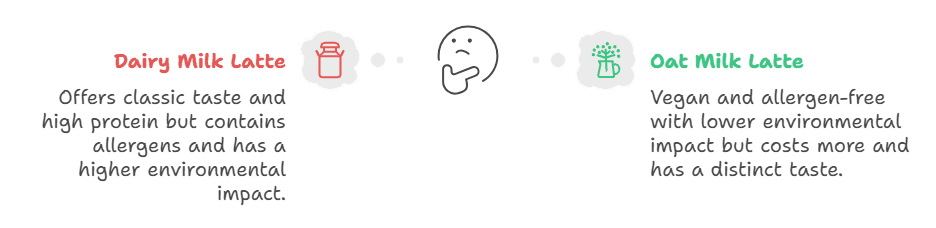
The Verdict: Which Milk Makes Your Perfect Latte?
There’s no single “best” choice – only the best choice for your priorities.
- Choose Dairy Milk if: You want the absolute benchmark in steaming performance and classic latte taste, aren’t lactose intolerant or vegan, and prioritize cost-effectiveness.
- Choose Oat Milk if: You need or prefer a plant-based/vegan option, need to avoid lactose/dairy/nuts/soy, prioritize lower environmental impact, and still want a creamy texture and good steaming performance (and are willing to pay a bit extra).
Ultimately, both whole dairy milk and barista edition oat milk can create delicious, creamy lattes. The subtle differences in taste, texture, and performance might sway you one way or the other.
Conclusion: Enjoy Your Latte!
The rise of high-quality oat milk means that enjoying a satisfying plant-based latte is easier than ever. Don’t be afraid to try both side-by-side if you can! Discovering your personal preference is part of the fun of exploring the coffee world. Whichever you choose, enjoy that perfectly crafted latte!
 Coffee Guide
Leave a comment