
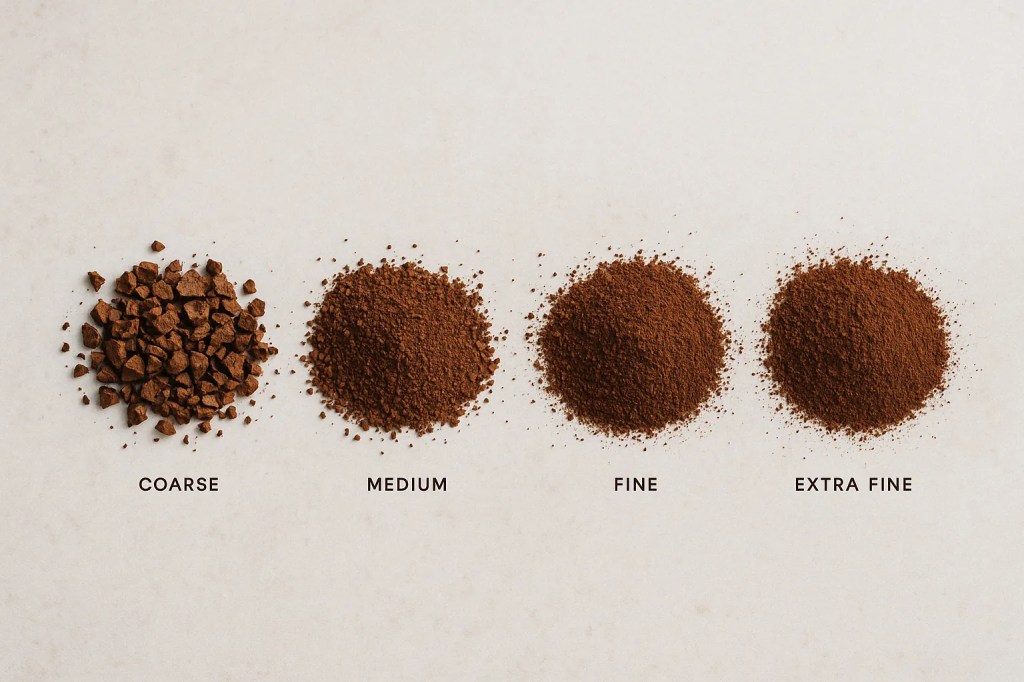
So, you took the leap! You ditched that noisy blade grinder and got yourself a proper burr grinder (high five!). You’re grinding fresh beans right before you brew… but maybe your coffee still tastes a bit… off? Sometimes bitter, sometimes sour, never quite perfect?
Don’t worry, you haven’t wasted your money! There’s one more crucial piece to the perfect-cup puzzle: the size of your coffee grounds. Getting this right is just as important as grinding fresh!
Using the wrong grind size for your coffee maker is a super common mistake, and it’s often the secret culprit behind a bad brew. But luckily, it’s easy to fix! This simple cheat sheet will explain why size matters and give you a starting point for matching your grind to your brewer.
Why Does Grind Size Matter So Much? (A Super Simple Explanation)
Remember we said hot water pulls flavor out of coffee grounds? Think of it like making tea – the longer the tea bag sits in water, the stronger the tea gets. Coffee is similar!
- The Goal: We want to pull out just the right amount of yummy flavor – not too much (bitter!) and not too little (sour!). This perfect point is called “extraction.”
- Size = Speed: Finer grounds are like tiny little bits with lots of surface area. Water can grab flavor from them REALLY FAST. Coarser grounds are bigger chunks with less surface area, so water pulls flavor out much SLOWER.
- Match the Time: Different coffee makers keep water touching the coffee for different amounts of time. Espresso is super fast (like 25-30 seconds). French Press is slow (like 4 minutes). You need to match your grind size (speed) to your brewer’s contact time!
Get it wrong, and disaster strikes:
- Too Fine + Slow Brew = Bitter: Flavor gets pulled out too much. Yuck.
- Too Coarse + Fast Brew = Sour/Weak: Not enough flavor gets pulled out. Blah.
Your Grind Size Cheat Sheet (Matching Grounds to Brewers)
Okay, here’s a guide to get you started. Check the coffee grind size guide below and the descriptions afterwards! Remember, this is a starting point – you might need to tweak it slightly (“dial it in”) for your specific beans and setup.
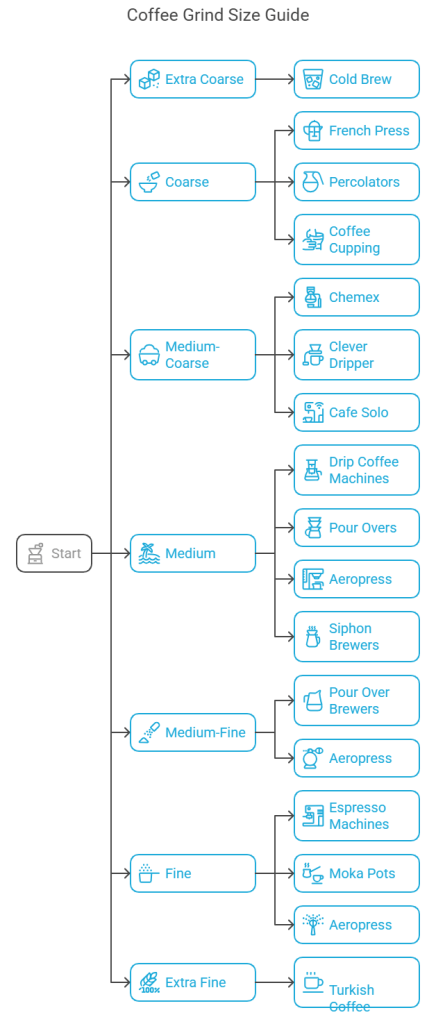
- Extra Coarse:
- Looks Like: Chunky sea salt, cracked peppercorns. Very large particles.
- Good For: Cold Brew coffee.
- Why: Cold brew takes hours (like 12-24!), so you need very slow flavor release.
- Coarse:
- Looks Like: Kosher salt, rough sand. Still quite chunky.
- Good For: French Press, Percolators, Coffee Cupping.
- Why: These methods have longer contact times (around 4 mins for French Press), needing slower extraction.
- Medium-Coarse:
- Looks Like: Coarse sand, maybe flaky sea salt. Noticeably smaller than coarse.
- Good For: Chemex, Clever Dripper, Cafe Solo brewers.
- Why: Brew times are often a bit shorter than French Press.
- Medium:
- Looks Like: Regular beach sand or granulated sugar. This is often the middle ground.
- Good For: Flat-bottomed Drip Coffee Machines, cone-shaped Pour Overs (like V60 – good starting point), Aeropress (longer brews), Siphon Brewers.
- Why: Fits the “average” brew time of many popular methods.
- Medium-Fine:
- Looks Like: Finer than sand, maybe like table salt. Getting closer to powder but still gritty.
- Good For: Cone-shaped Pour Over brewers (like Hario V60, Kalita Wave often prefer this), Aeropress (shorter brews).
- Why: Cone shapes can sometimes brew a bit faster, needing slightly quicker extraction.
- Fine:
- Looks Like: Finer than table salt, almost like powder but feels gritty between fingers. Think fine sugar.
- Good For: Espresso machines, Moka Pots (stovetop “espresso”), Aeropress (very fast “espresso-style” brews).
- Why: Very short, high-pressure brewing needs flavor released super fast.
- Extra Fine (Turkish):
- Looks Like: Flour, powder. Absolutely no grit.
- Good For: Turkish Coffee.
- Why: This unique method involves simmering powder-fine coffee and water together, and the grounds are often consumed with the drink.
What About Consistency? (Why Burr Grinders Win Again)
Quick reminder: why did we ditch that blade grinder? Check out our previous post if you haven’t seen yet! Because it made dust and boulders all at once! Even if you tried to get a “medium” grind, you’d get a messy mix.
A good burr grinder doesn’t just let you choose a size; it gives you grounds that are mostly all the same size. This consistency is the secret weapon. It lets the water extract flavor evenly from all the grounds, hitting that delicious sweet spot instead of being a bitter/sour mess.
Finding Your Perfect Grind (Dialing It In)
This cheat sheet is awesome, but coffee is fun because there’s always room to experiment! Different beans, roasts, and even water can change things slightly. Think of the cheat sheet as your starting point, then “dial in” your grind:
- Taste Test: Brew your coffee and really taste it.
- Too Bitter or Harsh? Your grounds were likely too fine (flavor extracted too much). Try grinding a little coarser next time. Or you can check our comprehensive guide for eliminating bitter coffee!
- Too Sour or Weak? Your grounds were likely too coarse (not enough flavor extracted). Try grinding a little finer next time.
Make small adjustments, brew again, and taste. It might take a few tries, but finding that perfect setting for your setup is super satisfying!
Conclusion
See? Grind size isn’t scary – it’s just about matching how fast flavor comes out (size) with how long your brewer takes! Get the size right, make sure it’s consistent, and you’re well on your way to amazing coffee.
Use this cheat sheet, trust your taste buds, and don’t be afraid to make those small adjustments. Happy brewing!
What’s your favorite coffee maker, and what grind size usually works best for you? Share your tips or questions in the comments below!


Leave a comment